The Full Story
A timeline of extraordinary sweetness
Ancient
West Africa — Centuries of Indigenous Use
Long before any scientist had named it, the indigenous peoples of West Africa's rainforest belt were incorporating the katemfe plant into daily life. Women wrapped foods in the broad leaves of Thaumatococcus daniellii — the leaves impart a sweet coating to anything they touch. Children chewed the soft red arils for their intensely sweet taste. Traditional healers used the fruit to make bitter herbal medicines palatable for patients. The safety record spans centuries.

The Congo River Basin, Central Africa · c. 1900 · The rainforest home of Thaumatococcus daniellii
1839
William Freeman Daniell — First Scientific Description
British botanist and army surgeon William Freeman Daniell became the first Western scientist to formally describe the katemfe plant. Stationed in West Africa with the British Army, Daniell observed the local use of the fruit and documented its remarkable sweetness. The species was named Thaumatococcus daniellii in his honor — from the Greek thauma, meaning marvel or wonder. The naming itself tells the story.
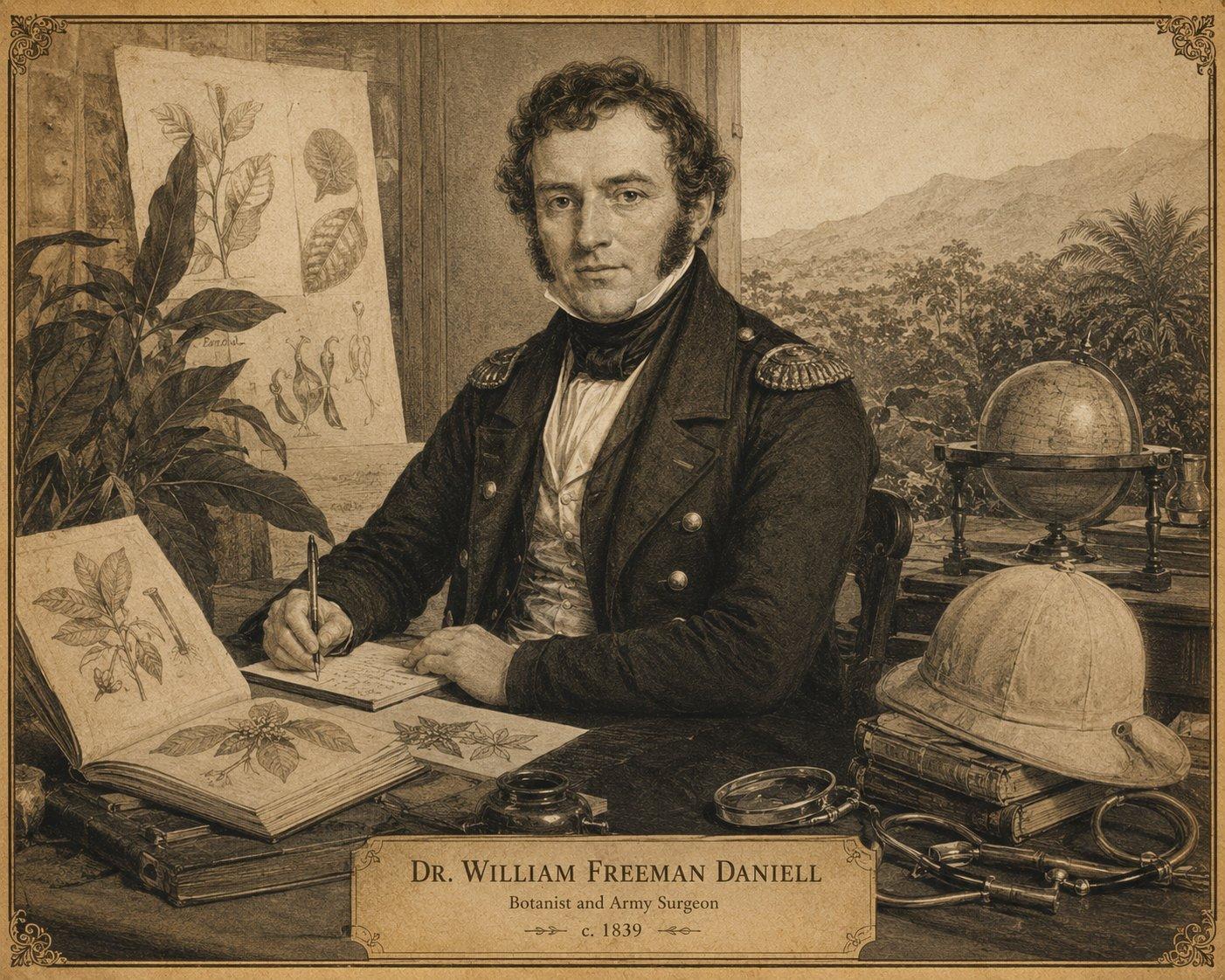
Dr. William Freeman Daniell · Botanist and Army Surgeon · c. 1839 · First scientific description of Thaumatococcus daniellii
1972
The Protein is Isolated — Van der Wel & Loeve, Unilever Research
Food scientists H. van der Wel and K. Loeve at Unilever Research in Vlaardingen, Netherlands successfully isolated the specific protein responsible for the katemfe plant's sweetness. They named it thaumatin. Their work established the fundamental science: a protein, intensely sweet, safe, water-soluble, heat-stable. Two primary isoforms — Thaumatin I (22,209 Da) and Thaumatin II (22,293 Da) — both active as sweeteners, both composed of 207 amino acids.
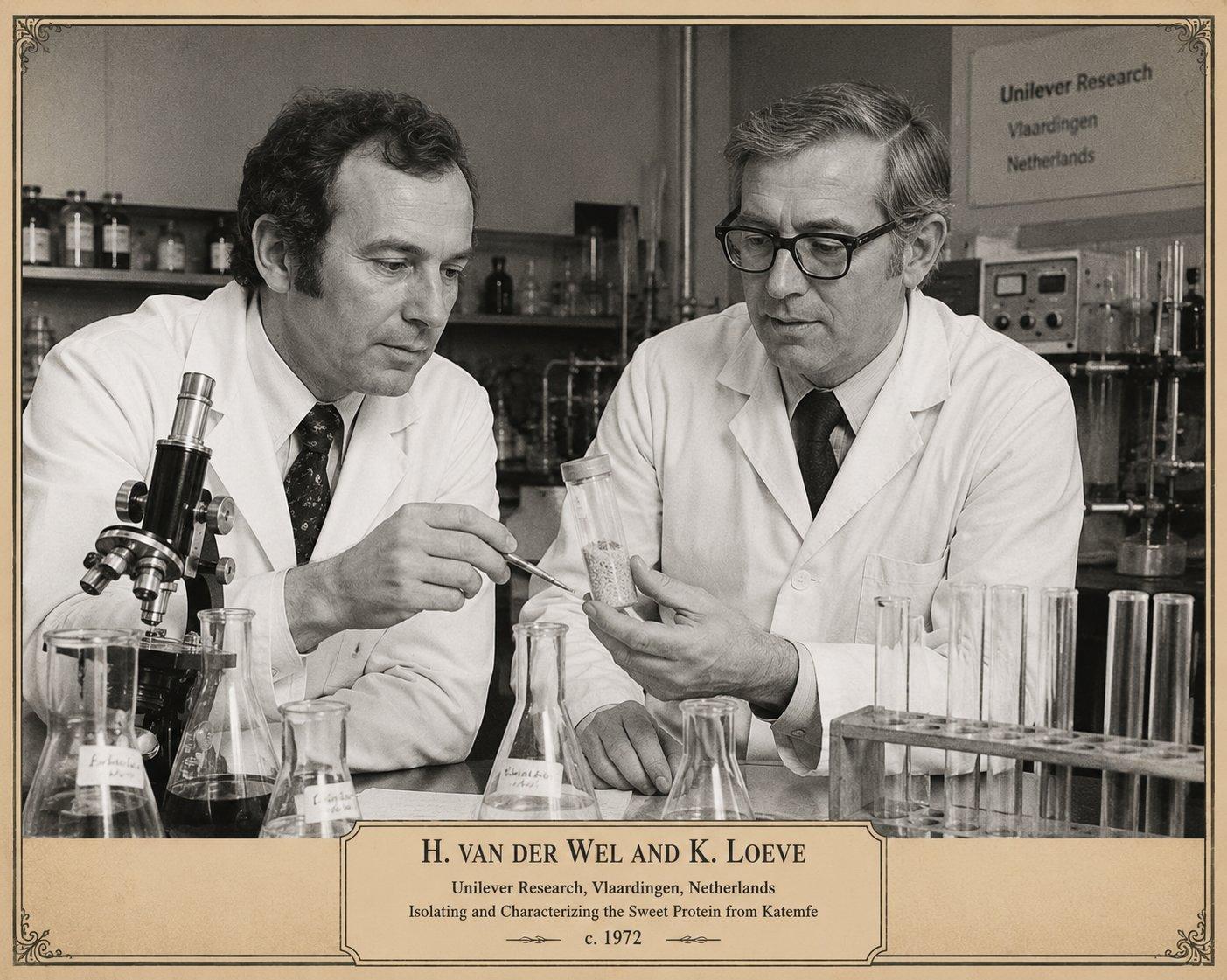
H. van der Wel and K. Loeve · Unilever Research, Vlaardingen, Netherlands · Isolating and characterizing thaumatin · c. 1972
1979
JECFA Review — ADI "Not Specified"
The Joint FAO/WHO Expert Committee on Food Additives assigned thaumatin an ADI of "not specified" — the highest possible safety designation in food additive science. This means available data showed no harmful effects at any realistic intake level. A "not specified" ADI is the gold standard. Thaumatin earned it on its first review.
1984
European Union Approval — Food Additive E957
The European Union formally approved thaumatin as a permitted food additive under designation E957. Europe has historically maintained stricter food additive standards than the United States — the EU approval therefore carried significant weight. Thaumatin joined the EU's list of approved sweeteners and flavor enhancers, where it remains today.
1990s–2000s
Global Commercial Adoption
The commercial food industry quietly adopted thaumatin at scale. Food technologists discovered its remarkable secondary property: beyond sweetness, thaumatin is an exceptional flavor modifier and bitterness masker. Without consumer awareness, it became a staple in thousands of products — from sugar-free gums to sports nutrition to dairy alternatives.
2018
US FDA GRAS Notification — GRN 000910
The US Food and Drug Administration accepted GRAS Notice No. GRN 000910 for thaumatin. North America subsequently became the largest single consuming region, now accounting for over 36% of global thaumatin consumption.
2025
The Aspartame Reckoning
A landmark study in Cell Metabolism demonstrated that aspartame triggers insulin release via vagus nerve activation and promotes atherosclerotic plaque formation in both rodent and primate models. Combined with the WHO's 2023 IARC classification of aspartame as a Group 2B possible carcinogen, the case for a genuinely safe, natural alternative had never been stronger.
2026
Pure Plant Sweet™ — Available to You
Centuries of indigenous knowledge. Decades of scientific validation. Five clean ingredients. One drop. This is where the story arrives at your kitchen.